


 SIGN UP FOR OUR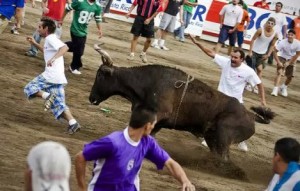
Source: Flickr Commons
In Costa Rica, Christmas and the end of the year holidays bring a lot of cheer to residents and visitors. One of the most expected events of the holiday season is called Toros a la Tica, which some people wrongly characterize as bullfights, but in reality they fall somewhere in between the Running of the Bulls in Pamplona and the North American rodeos. Ostensibly, these are family-friendly events; however, some activists claim that they are nothing but cruel spectacles.
From Christmas Day until January 5th, the Zapote fairgrounds in the eastern suburbs of the Costa Rican capital of San Jose will turn into a potpourri of fun. Visitors can expect live music, dancing, amusement rides, games, delicious and unhealthy food, copious amounts of beer, trinkets galore, and fireworks. Amidst this amalgamation of fun stands the bullring, where men (and a few women) square off against bulls.
Inside the bullring, there will be some displays of equestrian skill and brave bull riding; this is standard rodeo fare. What people pay a considerable amount of money to see is the “improvised bullfighters,” who don’t actually fight as much as taunt the bull into charging them and chasing them around the ring; in other words, they are like volunteer rodeo clowns. If this does not sound logical, it’s because it isn’t; however, it is a tradition that dates back to at least 1868.
No one knows why Spanish bullfighting never really caught on in Costa Rica. What you see taking place in Zapote, Guanacaste and many other communities across the country is pretty much what used to take place during the holidays at La Sabana Metropolitan Park: amusement rides, dancing, food, drinking, fun, etc. In Costa Rica, there has never been a great interest in a toreador risking his life to kill a bull in front of an audience.
By 1950, the holiday fairgrounds moved from La Sabana to Plaza Viquez, also in the lovable city of San Jose. After that, the bulls moved around the Morazan Park and Barrio Vasconia until they arrived in Zapote in 1969. The bullring plaza was demolished in 2003; this prompted the spread of rodeo-like events to other spots such as La Guacima Speedway, province of Alajuela, in 2006.
The Cruelty Claims
Deriving enjoyment from watching people voluntarily taunt a bull and then run away as it charges and gives chase is probably an approximation of what audiences at the Roman Coliseum enjoyed centuries ago. But when injuries happen, which is often, the fun stops.
Sometimes humans are injured, but the bulls suffer injuries as well. It’s not just the bulls that get irritated; just about every year a Tico gets upset after being tossed around by the bull and walks up to the animal to deliver a swift slap or punch to the head before walking off the ring while mouthing off expletives. The bull is usually quite confused by this exchange, at least until it is taunted again.
Spanish bullfights date back to the 18th century, and opposition thereof -on the basis of cruelty to animals- emerged at around the same time. Opponents are not limited to animal rights activists; the Catholic Church and politicians have repudiated the events throughout history. Organized opposition against Toros a la Tica on the basis of cruelty are fairly recent. The Frente De Resistencia Animal y De La Tierra (Animal and Earth Resistance Front) has been the most vocal and successful group in this regard. Before this group, biologist Olga María Rodríguez Herrera was the most outspoken.
The Front’s activities started in 2011, and they were successful in drawing the attention of the media to their cause. This group does not buy into the tautology that taurine events in Costa Rica are more humane because they do not involve killing the bull.
The Front was successful earlier this year in stopping a Pamplona-style bull run from taking place in Costa Rica; they did this by obtaining a ruling from Constitutional Court (Sala Cuarta). What is interesting about this achievement is that the Front enlisted the support of dairy farmers and cattle ranchers in presenting an amicus curiae (friend of the court) brief that explained their position: Taurine events are cruel insofar as animals are not being raised for consumption or as beasts of burden for the purpose of human welfare.
Cattle ranchers and the Front may be strange bedfellows in the fight against taurine cruelty, but they have set an important precedent. They certainly have their work cut out for them: Toros a la Tica is a lucrative industry that is televised nationwide and a major commercial anchor of the holiday festivities in Costa Rica.



