


 SIGN UP FOR OUR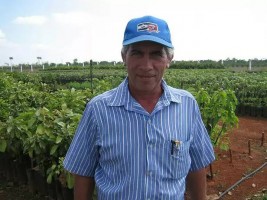
A Cuban Farmer. Source: Flickr
Havana, Mar 2 (EFE).- Almost 100 U.S. agri-businessmen visiting Cuba on Monday supported an end to the embargo on the island and said they were ready to push the productive sector there, one of the economy’s most acute needs given that Cuba spends $2 billion per year to import food.
The businessmen are representatives of the U.S. Agricultural Coalition for Cuba, some 30 agricultural and food production organizations who in January joined together to promote lifting the embargo and being able to freely sell their products on the communist island.
The organization’s chairperson, Devry Boughner, said at a press conference that the group was in Cuba to “send a message” that the coalition is working hard to end the embargo and that its members are encouraged that their visit will help promote results, understanding and friendship with the Cuban people.
Boughner, the director of international business relations for the multinational Cargill, said that in the coming months the group will work closely with the U.S. Congress to promote lifting the embargo, an option that has the “support of a broad majority” of lawmakers.
She said the group’s members would speak with the leaders of both legislative chambers about their trip to Cuba and continue to have those discussions to try and join forces to end the embargo.
The USACC has become one of the most powerful pressure groups for normalizing relations with Cuba and the first to travel to the island to deal directly with the authorities there.
The businessmen arrived on Sunday in Cuba and held meetings in Havana on Monday with various officials, including Foreign Minister Bruno Rodriguez, Agriculture Minister Julian Gonzalez, representatives of the sugar industry and the cooperatives gathering together small agricultural producers.
Among the 96 delegation members visiting Cuba are two former U.S. agriculture secretaries: John Block, who served from 1981-1986 during the Ronald Reagan administration, and Michael Espy, who served from 1993-1994 under Bill Clinton.
Block said that the coalition’s aim is to exceed $1 billion in food exports to Cuba, a quantity that was achieved in 2008 when sales of U.S. agricultural products to the island jumped after the passage of Hurricanes Ike and Gustave.
By 2014, U.S. food exports to Cuba had fallen to $300 million. “It’s a long road ahead,” the former secretary said.
Block went on to say that the group does not just want to sell corn and soybeans to Cuba but rather wants to help Cuban farmers develop the agricultural sector there.
They already did it in Africa and Eastern Europe, in Ukraine and Moldova, he said, and now they want to do it in Cuba, too.
Espy said that last year frozen chicken comprised 40 percent of U.S. food sales to the island, and soybeans comprised 30 percent, noting that corn and wheat sales have fallen off markedly in recent years.
The coalition also said it intends to resume sales of rice to the island, which have been nonexistent since 2008, whereas before 1959 – before the Cuban Revolution brought Fidel Castro to power – Havana was the main worldwide buyer for U.S. rice. EFE



