


 SIGN UP FOR OUR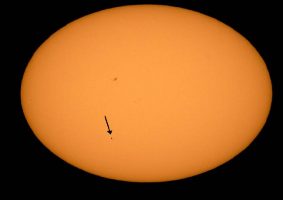
Source: NASA
Washington, May 9 (EFE).- The planet Mercury on Monday made its first transit of the Sun in a decade, an unusual event that NASA broadcast live on its Web page.
For about 7 1/2 hours, Mercury was visible from Earth as a tiny black disc crossing in front of the fiery Sun, a spectacle recorded for the first time by NASA’s Solar Dynamics Observatory, a telescope launched in 2010.
The passage of the closest planet to the Sun across the solar disc, which astronomers call a “transit,” began at 1116 GMT and ended at 1838 GMT. The phenomenon was visible from the entire Western Hemisphere, Europe, Africa and a large part of Asia.
A transit occurs when a planet passes directly between the Sun and the Earth, and this is Mercury’s first transit since 2006.
The tiny planet will make its next transit in 2019 and NASA says that the event occurs only 13 times per century.
Mercury orbits the Sun in 88 days, meaning that technically the planet passes between the Sun and the Earth rather frequently, about three times per year, in fact.
However, Mercury makes a transit only every 9 years, on average, because its orbit and that of the Earth differ by about seven degrees, meaning that Mercury does not appear to cross the solar disc every time it moves between the Sun and Earth.
Scientists around the world followed Mercury with telescopes on Monday and a photograph of the planet’s silhouette passing over the left lower portion of the Sun’s disc was selected by NASA as its “photo of the day.”
Chatter on the social networks showed how popular the slow passage of Mercury across the Sun was for amateur astronomers, but scientists say that the phenomenon provides key information about the Solar System. EFE



