


 SIGN UP FOR OUR
Click image to enlarge

Editor’s note: The views expressed by guest columnists are not necessarily those of The Costa Rica Star, its advertisers, or its staff.
President Donald Trump arrived in Corpus Christi, Texas Tuesday morning to see firsthand the devastation inflicted upon southeast Texas when Hurricane Harvey slammed the Gulf Coast Friday night – leveling the popular beach town of Rockport and leaving millions homeless and stranded throughout the region from Corpus Christi to the state of Louisiana.
This first major disaster for President Trump is unprecedented in its scope of destruction. There is no doubt now that this disaster will exceed Hurricane Katrina hitting New Orleans in 2005 — the nation’s costliest natural disaster on record. This is uncharted territory for the president and his homeland security team plus the Federal Emergency Management Agency (FEMA). These two agencies – along with the White House — are primarily responsible for coordinating long-term recovery efforts by working closely with local and state officials.
In his comments from Corpus Christi, President Trump promised swift financial aid and resources to get southeast Texas back up and running. The U.S. Congress must deal with an immediate multi-billion-dollar aid package without delay. To politicize this disaster would be a huge political mistake. To screw up this recovery effort would be reminiscent of the awful government response to Katrina. That would also be a huge political mistake, something President Trump so far is avoiding.
“We want to do it better than ever before,” Trump said. “We want to be looked at in 5 years or ten years from now as this is the way to do it … This was of epic proportion. Nobody has ever seen anything like this.”
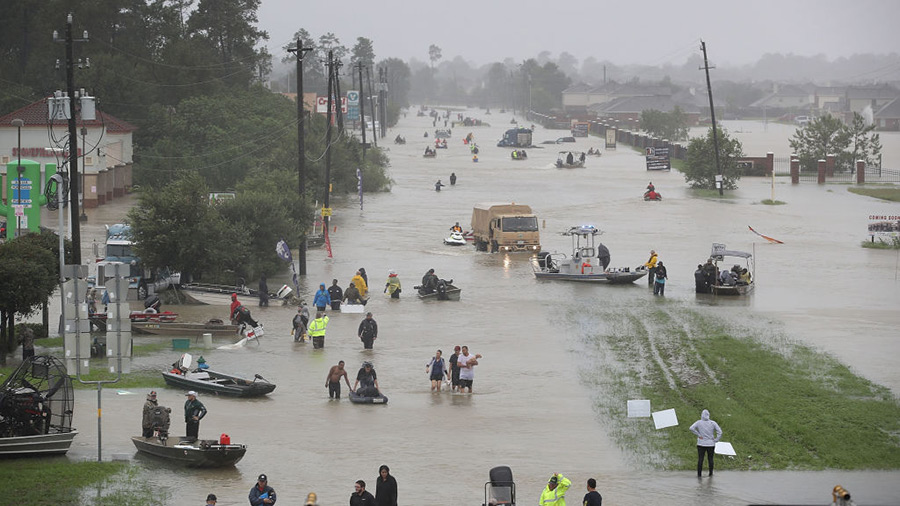
By Wednesday levees around Houston had broken, adding to the flooding. Several Houston reservoirs are over-flowing into downtown Houston. Some 58 counties in southeast Texas and much of Louisiana are underwater with a record-setting rainfall measured Tuesday at 49.32-inches since Friday night. Some estimates are up to 52-inches of rain in and around Houston. Cities and towns east of Houston — such as Port Arthur, Beaumont and Orange — are flooded out all the way to the Louisiana border and beyond.
“There is no hindsight in an event that has never happened before,” said Houston Police Chief Art Acevedo in a Tuesday morning press briefing on CNN. This statement pretty much sums up what’s going on in Texas.
Houston is the U.S.’ fourth most-populous city – with 2.3 million residents — and it’s out of business. Millions of single-family homes and trailers, apartments and businesses are flooded and unreachable until the snake and alligator infested waters subside which could take weeks or months. The death toll is has risen to 31, but most of these homes have yet to be searched for victims.
Words are weak in describing the level of human despair in southeast Texas. Once dry public shelters, housing hundreds, have begun to flood. News reports say more than a million vehicles are destroyed. Area oil refineries are shut down and no longer producing gasoline. Damage to infrastructure — such as roads and bridges — is unknown because it’s all flooded. Recovery will take years. The magnitude of this disaster is the problem. Resources are arriving from around the nation to support the afflicted.
TV news reports coming from the disaster show an amazing “all-hands-on-deck” effort underway with federal and local officials pleading with the public to join in with the rescue efforts. Even the ‘Cajun Navy’ – a group of volunteer boat owners from south Louisiana — showed up with dozens of flat-bottom boats for search-and-rescues. Blacks helping whites, whites are helping Latinos alongside local, state and federal emergency professionals, the Texas National Guard, the U.S. Army National Guard and the U.S. Coast Guard.
There’s not any political racial talk in Houston right now. Nobody’s going after statues and no protests are underway. If there’s a blessing here it’s that people of all colors from all walks of life are coming together to survive this historic tragedy as best they can. Neighbors helping neighbors. Strangers helping strangers.
This disaster is very much in the hands of the U.S. Congress to approve the funding to rebuild southeast Texas. There will be no delay on the part of President Trump or his team. For the most part, the president’s critics are biting their tongues right now and they should. This disaster is no place for petty partisan politics.
The end of hurricane season is still 9 weeks away. New storms are forming off the coast of West Africa and will be headed West across the Atlantic Ocean threatening the Caribbean, Central America and the U.S. This year there could easily be still another Houston … another Katrina.
About the Author
Britt Nelson relocated to Costa Rica in 2011 from Florida, where he served as news editor for the Palatka Daily News, a newspaper owned by the New York Times Regional Newspaper Group (NYT-RNG) for 20 years.
Nelson served the NYT-RNG for 18 years in Tennessee, Kentucky, Virginia, North Carolina and Florida as a correspondent, reporter, staff writer, senior staff writer training new reporters, copy editor, page designer, editorial writer, editorial page editor and editorial board member.



