


 SIGN UP FOR OUR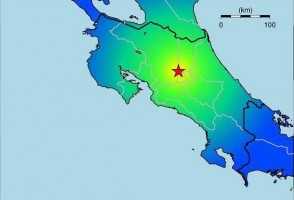
Intensity map by RSN (UCR)
UPDATE: The 11:05 earthquake, magnitude 4.2 with an epicenter north of San Ramon in the province of Alajuela, is not part of the Cinchona cluster. It is important to keep in mind that Costa Rica is a seismic country.
Three strong earthquakes followed by more than 70 aftershocks rudely awakened residents of a seismic region of Costa Rica on the final day of March. The first seismic disturbance was recorded at 3:09 am; it was a magnitude 4.6 quake with an epicenter located two kilometers north of Vara Blanca, province of Heredia.
According to a report issued by the Observatory on Seismology and Volcanology of Costa Rica (Spanish acronym: OVSICORI), the earthquake was strongly felt across the Central Valley and jolted thousands of residents awake, many of whom were unable to go back to sleep.
As of 7:18 am, OVSICORI scientists had recorded 76 aftershocks, 48 of them with a clear epicenter. This seismicity corresponds to the earthquake cluster located in Cinchona, a community that was deeply affected by a powerful quake in 2009. The depths of the epicenters have been measured around 4.5 and 6.2 km, and the strongest aftershock presented a 3.7 magnitude.
The first earthquake cluster of 2015 was announced in this region, which encompasses Cinchona, Vara Blanca, Los Cartagos (not to be confused with the province of Cartago), and San Bosco. Residents who remember the disastrous 2009 Cinchona earthquake have been pretty nervous since March 18th, when the earthquake cluster caused several earth tremors in just a few hours. No injuries from this latest earthquake have been reported, and the damage has been limited to fallen household items, broken dishes, cracks on walls, etc.
A displacement of geological faults located between the Barva and Poas volcanoes in Costa Rica are to blame for keeping Ticos awake this morning. These faults were activated in 2009 by the Cinchona earthquake, and thus geologists note that the earthquake cluster and the ensuing seismicity is not volcanic in nature. Still, some residents tend to associate eruptions from the Turrialba volcano with the temblors; for this reason, many people skipped going back to bed and headed to church to wait for morning Mass.



