


 SIGN UP FOR OUR
  The holiday season in Costa Rica makes biologists and taxonomists very happy. This is the time when scientists and volunteers hit the field to conduct the traditional Christmas species count. Since Costa Rica is known for her rich biodiversity, each count is an opportunity to run into a rare species or even begin an investigation into a new organism for proper classification.
As previously reported by the Costa Rica Star, 5,000 new species across various biological kingdoms, including Plantae and Animalia, were added to the taxonomy record of this country. This gain in species was observed as part of Costa Rica’s National Biodiversity Strategy (ENB in Spanish) for 2014-2020, which is part of the United Nations Environment Program’s (UNEP) Strategic Plan for Biodiversity and the Convention on Biological Diversity.
Storks, wasps, fairy flies, vines, orchids, and butterflies are just some of the new species classified in 2013. Biologists are optimistic that more species will be found in the future as taxonomical efforts continue. Some of the species added in 2013 are particularly interesting; such is the case of seven new chewing lice parasites that live in the feathers of songbirds related to the lovely yiguirro, an important national symbol of Costa Rica.
Sharks, rays, bats, and -of course- birds are the species currently being counted by scientists and volunteers in Costa Rica around Christmas time. These events are significant in the sense that they yield important biological factors such as species density and overall biodiversity. According to a recent article by Michelle Soto of national newspaper La Nacion, the chiropteran group was lucky to encounter the odd-looking Centurio cenex, a fruit-eating bat that has alien-like facial features.
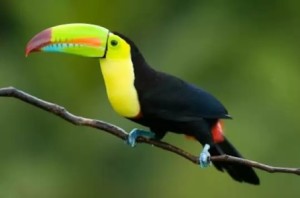
The most abundant Christmas species count in Costa Rica belongs to the ornithologists. Thanks to reforestation and nature conservation efforts across the country, birds abound in most ecosystems. Bird counts are beneficial not just for scientific purposes; positive results can be used to entice birdwatchers to visit Costa Rica, thus stimulating the tourism economy. Birdwatchers are perhaps the nicest tourists Costa Rica can hope to attract; they are well-educated and ecologically-conscious -and this is just one of the many reasons biodiversity must be protected.



