


 SIGN UP FOR OUR
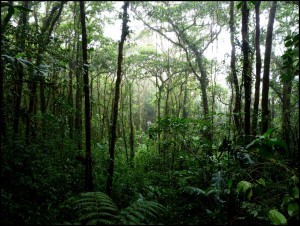
As researchers scramble to understand how ecosystems react to the earth’s changing climate, forests, especially tropical rainforests, are top on the list.
This is because of their huge capacity to be “carbon sinks” or absorb tons of carbon pollution – from burning fossil fuels – that creates the greenhouse effect, or warming of the earth’s climate.
As global temperatures rise, and rainfall increases, and “Conventional wisdom has held that forest growth will dramatically slow with high levels of rainfall,” said Colorado University scientists.
It was when Philip Taylor, who is now a research associate with the Institute of Arctic and Alpine Research (INSTAAR) in Boulder, Colorado, was doing his dissertation research on ecology and evolutionary biology on the Osa Peninsula of Costa Rica, began to question this assumption.
“Our data suggest that as large-scale climate patterns shift in the tropics, and some places get wetter and warmer, forests will accelerate their growth, which is good for taking carbon out of the atmosphere,” continued Taylor. “In some ways, this is a good-news story, because we can expect greater CO2 uptake in tropical regions where rainfall is expected to increase. But there are a lot of caveats.”
Ecologists, who have mainly studied more accessible forests in temperate zones, have traditionally described forest growth as following a hump-shaped curve when it comes to precipitation in which more rainfall leads to more growth only up to a certain point — after about 8 feet per year, scientists thought too much water would waterlog the ecosystem and slow growth.
Speaking of his research in southern Costa Rica’s very wet rainforests, “Here we were in a place that got 16 feet of rain per year, and it was one of the most productive and carbon-rich forests on earth. It clearly broke from the traditional line of thinking,” said Taylor.
Taylor spent four years synthesizing data on temperature, rainfall, tree growth and soil composition from rainforests in 42 countries, compiling what he believes is the largest pan-tropical database to date.
The study, published in Ecology Letters, found that cooler forests (below 68 degrees F on average), which make up only about 5 percent of the tropical forest biome, seemed to follow the expected hump-shaped curve. But warmer forests, which form the majority of tropical forests, did not. In fact, more water increased their growth.

Philip Taylor measures the growth rate of a tropical giant, the Ajo, on the Osa Peninsula in Costa Rica. The trees can grow to 180 feet tall and can live 1000 years.
However, said Taylor, “A lot of climate change is happening at a pace far quicker than what our study speaks to,” he says.
“Our study speaks to what we can expect forests to do over hundreds of years,” explained Taylor who cautioned this doesn’t mean climate change won’t harm tropical forests at all. For example, recent droughts in the Amazon Basin led to widespread plant death and a 30 percent decrease in carbon accumulation in the past decade, and are attributed to climate change.
“The implications of the change still need to be worked out, but what we can say is that the forest responds to changes in rainfall quite differently than what has been a common assumption for a long time,” said Townsend.
“Our findings fundamentally change a view of the tropical forest carbon cycle that has been published in textbooks and incorporated into models of future climate change for years,” said Taylor. “Given how much these forests matter to the climate, these new relationships need to be a part of future climate assessments.”



