


 SIGN UP FOR OUR
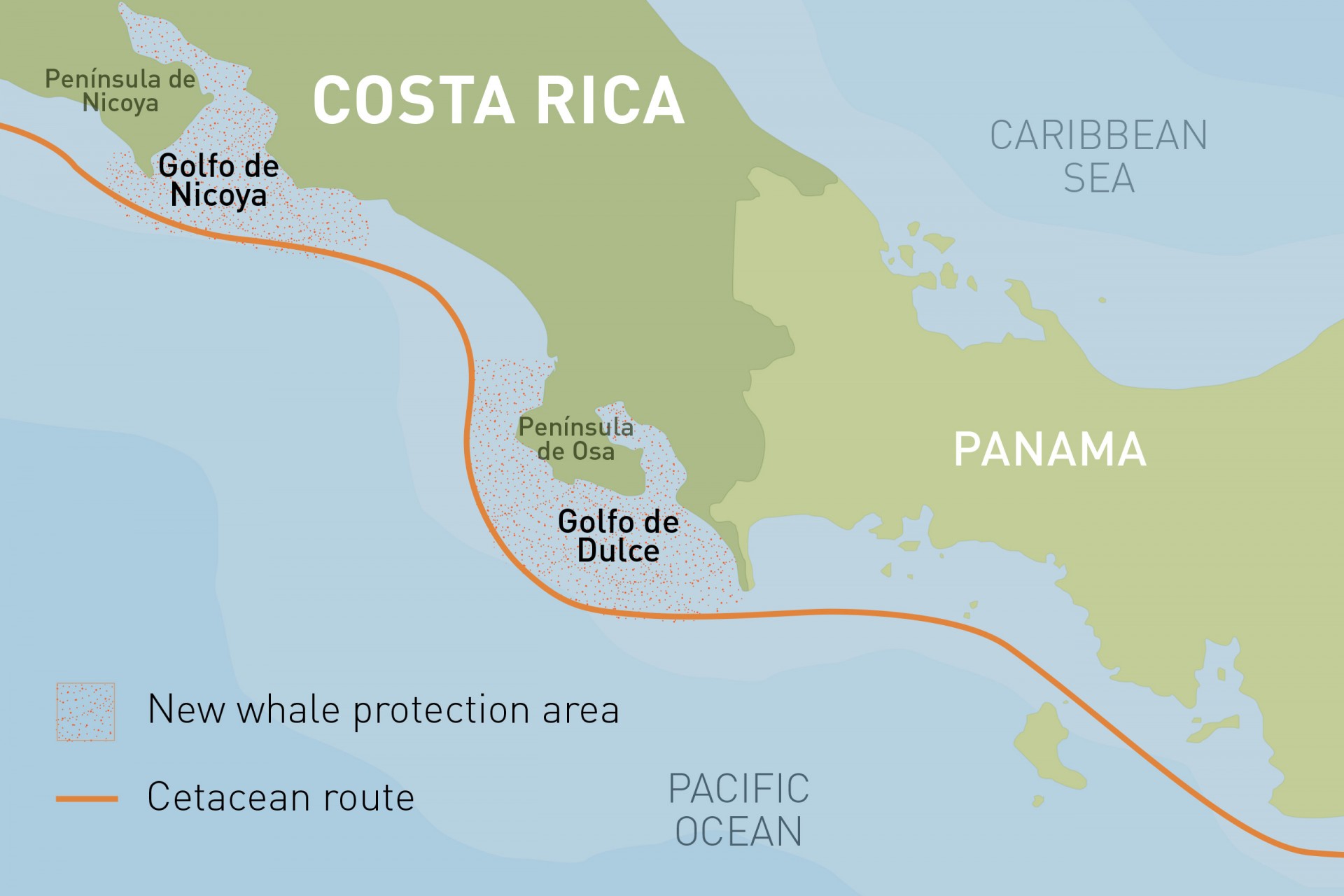
Through an executive decree, Costa Rica will establish safe routes in waters of the Pacific to increase marine security and prevent collisions between vessels and cetaceans.
By creating an “Area-to-be-Avoided” and a traffic separation scheme, the country hopes to protect marine environment, particularly the migratory population of humpback whales and other cetaceans that travel the waters of Golfo Dulce and Golfo de Nicoya.
Costa Rican authorities received the assistance of marine ecologist, Hector Guzman from the Smithsonian Tropical Research Institute in Panama.
“We provide an important complement to marine policy by obtaining satellite tracking information to model the spatial distribution of individual tagged whales in southern Costa Rica,” Guzmán said. “This helps to define potential areas where collisions between cetaceans and large merchant ships are likely. New maritime transit routes should reduce collisions between large ships and whales and also protect areas for artisanal fishermen by increasing the distance of ships from the coast”, concluded Guzman in statements for the Smithsonian Institute.
The International Maritime Organization (IMO) expressed in a document published in December 2016 by the Sub-Committee on Navigation, Communications and Search and Rescue (NCSR), that “the intensification of merchant maritime transport threatens to increase collisions with large migratory species, such as whales and turtles.”
The decree establishes two “Areas-to-be-Avoided”, the Osa Peninsula and Pavon Bay.
“The guidelines will be included in standard digital and printed navigation charts used by merchant mariners. This will enable them to be followed by all sailors, reducing the probability of collisions between merchant ships and cetaceans in Costa Rican waters as has been achieved in the Panamanian Pacific”, explains the information published by the Smithsonian Institute.



