


 SIGN UP FOR OUR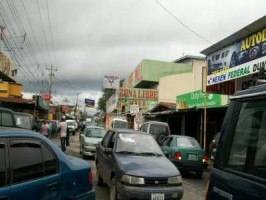
Vehicles crossing Paso Canoas in 2009
President Laura Chinchilla met with her Panamanian counterpart Ricardo Martinelli at the Sixaola southern border days ago to inaugurate a new bridge that will connect both Central American nations. The initial border crossing will be a provisional Bailey bridge, and it is expected to remain in place until both nations obtain $30 million in funding for the permanent structure. Aside from presiding over the inaugural ceremony, both Presidents mentioned their intention of enacting a treaty that would allow citizens of Costa Rica and Panama to cross the border without a passport.
The proposal from both Presidents has raised some eyebrows on both sides of the southern border, including those of Minister of Public Safety Mario Zamora. According to a news article written by Alvaro Murillo on national newspaper La Nacion, Minister Zamora made the following statements soon after the Presidents mentioned their intentions:
“This is not in writing and, at any rate, it would not be implemented immediately. The idea is to add some flexibility to the border crossings (of Paso Canoas and Sixaola) without sacrificing national security.”
Prior to the statement above, Minister Zamora also commented that the proposal was initially considered months ago, and has been under evaluation ever since. Since both countries share the use of a unique national identification document, citizens of either country would be allowed to cross the border by simply presenting their cedulas. Minister Zamora also expressed concerns over this fact by stating that:
“[…] a counterfeit cedula would be easier to make than a passport.”
Minister Zamora is not the only public official who has expressed concern over eliminating passport requirements on the the southern border. In the past, legislators and other high-ranking government employees have described the southern border as being “very porous”, meaning that members of organized crime groups and opportunistic criminals with ties to drug trafficking have entered Costa Rica thanks to the relaxed immigration policies of Panama, and the reported economic miracle that is transforming that nation.
The Dubaification of Panama
In a 2006 research paper by Ali A. Alraouf, a Professor of Architecture from the University of Bahrain, the terms “Dubaization” and “Dubaification” are used to describe how the Arab Emirate of Dubai was quickly transformed into a global city and an urban wonder thanks to the vision of progressive Sheiks who know that the oil wells that produce “the black blood of Allah” are drying up. The development of Dubai is not limited to dazzling the world; it is a calculated attempt to catapult the United Arab Emirates nation as a major player in the global economy -in other words to continue making piles of money once the last drop of oil has been extracted.
Aside from the amazing -and probably unsustainable- architecture, Dubai has also gone to great lengths to accommodate visitors from all over the world. The metropolis is home to a few areas that are similar to Free Trade Zones, where violations to Islamic sharia law are permitted to an extent in order to accommodate Western visitors who are used to consuming liquor and tobacco, among other customs.
Panama City has been undergoing quite a bit of Dubaification over the last few years, particularly under the administration of President Ricardo Martinelli. Side-by-side comparisons of the skylines of Panama City and Dubai bring up a few similarities, the Martinelli administration has also focused on heavy promotion and marketing of Panama as a premier tourism destination -probably to defer the enormous debt he is saddling the country with. To this extent, Panama has been making it very easy for South American tourists by eliminating visa requirements for citizens of Colombia and Ecuador over the last few years.
The Security Concerns
Ever since Panama eliminated the visa requirement for Colombian citizens, the number of illegal immigrants from that South American nation in Costa Rica has increased significantly. This is a major concern for many Ticos who worry about the country’s lax immigration policy. This is a bit of a Catch-22, however, since it is one of the main reasons behind the booming tourism that Costa Rica has always enjoyed, which is what Panama would like to foster.
What some Ticos fear is that South American citizens with dubious backgrounds can easily enter Costa Rica via Panama thanks to a land border that has just two crossing points, leaving more than 370 kilometers unguarded. Illegal immigration and smuggling are two illicit operations endemic to the southern border. Even the two border posts in Paso Canoas and Sixaola are lightly guarded -on the Costa Rican side.
Anyone who has made the land crossing at Paso Canoas and cleared immigration and customs on both sides is familiar with the contrast between the security forces of both Costa Rica and Panama. The process is far more organized and efficient on the Panamanian side, but is also more intimidating due to the suspecting and overzealous attitudes of militaristic police officers armed with assault rifles. Crossing over into Costa Rica is like entering a Shakespearean comedy of errors where security and efficiency take a backseat to charming bureaucracy with a smile.
Evidence of the relaxed security on Costa Rica’s southern border can be appreciated every weekend as many Ticos cross the border into Panama for quick shopping trips. Electronics, clothing, liquor, and even food items are coveted by Ticos who would otherwise pay a lot for the same items back home -sometimes many times over. Hundreds of Panamanians cross over the border into Costa Rica on weekends as well, but not for shopping. They come to our country for leisure activities, particularly of the nighttime variety. They are willing to pay more for liquor and food in exchange for a night out in a bar/restaurant where cops don’t barge in asking for identification papers, or pistol-whipping patrons who demand respect from the police. Panamanian police officers are known to operate in stark contrast to Fuerza Publica officers in Costa Rica.
Sixaola is a predominantly indigenous community, but in recent years it has attracted a number of foreigners interested in ecotourism, as well as perpetual tourists on visa runs who are looking for the coveted exit and entry stamps that will allow them a few more months of legal permanence in Costa Rica. Whereas crossing Paso Canoas can sometimes feel chaotic due to the number of travelers, Sixaola is far more relaxed and in the past has been a hub for illegal crossings and smuggling -although Fuerza Publica has stepped up its presence and vigilance in the area.
Ticos have good reasons to be concerned about the elimination of passport requirements at the southern border, but unless security is improved along the entire border, which mostly consists of dense jungle environs, the risk of illegal immigration and smuggling will always be present.
The Economic Impact
Should the proposal be enacted, a rung of the bureaucratic ladder -the passport industry- could be affected. Ticos don’t like to stray too far from their beloved country, but they do enjoy shopping trips to Panama. Banks in Costa Rica, along with the national Post Office, have recently added passport services in order to attract more customers and enjoy a fraction of the service fees. Doing away with passports may increase the number of Tico shoppers traveling to Panama, but others could be affected by a reduction in passport issuance, from photo studios to printers and government clerks. There is also the concern of too many Ticos spending their hard-earned colones on Panamanian bargains, thereby snubbing domestic commerce.
A previous article in The Costa Rica Star described how children born in Costa Rica to Nicaraguan parents are usually taken on illegal crossings in the northern border because their mothers and fathers think that passport service fees are excessive.



