


 SIGN UP FOR OUR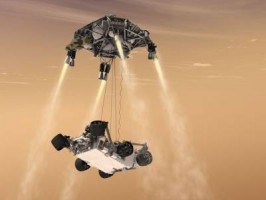
Source: NASA
SAN JOSE – Starting at 11:00 PM on Sunday, August 5th (0500 UTC/GMT on Monday, August 6th), TV viewers in Costa Rica will be able to watch live coverage of the latest United States National Aeronautics and Space Administration (NASA) mission to Mars on Teletica channel 7. The Mars Science Laboratory spacecraft is currently just a few hours away from the Red Planet. This space vehicle launched from Earth 36 weeks ago, and it carries the Curiosity rover -the most advanced planetary explorer ever deployed to outer space.
The aerospace community in Costa Rica is anxiously awaiting the safe landing of Curiosity in the Gale Crater of Mars, a gigantic depression in the Red Planet that it is believed to have resulted from the impact of a giant meteor roughly about the size of Cartago. On Friday, the Central American Aeronautic and Space Association (ACAE in Spanish) shared on its Facebook page a step-by-step chart of the delicate maneuvers that the mission must take in order for Curiosity to land safely. ACAE is one of the organizations dedicated to space exploration in Costa Rica. The Ad Astra Rocket Company, based in Liberia and Houston, has an even greater interest in the success of the Curiosity landing due to the work of Hall of Fame astronaut Franklin Chang Diaz.
Dr. Franklin Chang Diaz spoke to Teletica a couple of days ago about his expectations of this mission. As founder and CEO of Ad Astra, Dr. Chang Diaz is responsible for the design of a propulsion system that will one day power a mission to Mars much faster than current technology allows. Dr. Chang Diaz is currently in Houston, and he is confident that Curiosity’s ten planned experiments will be successful. Many of these experiments are intended to shed light on the mysterious possibility of life on Mars, a planet that keeps offering clues as to a chance of life -albeit it could be a much more different version than we know.
Dr. Chang Diaz mentioned that Curiosity’s mission will elucidate some conjecture he has with regard to his VASIMR plasma rocket project. Curiosity is a nuclear-powered device, which sets it apart from past solar-powered NASA equipment. Prototypes for the Ad Astra VX-200 VASIMR utilize a combination of complex power sources. Research into the VX-200 is firmly advancing, with Ad Astra securing important contracts, funding, and improving the maxiumum throttling range of the propulsion system. Space trials of VASIMR could be sent to the International Space Station by 2015, thus giving Costa Rica a chance to get closer to Mars, but positive results from the Curiosity experiments may accelerate the process.
Aside from watching the landing live on Teletica, you can also follow the mission online at:



