


 SIGN UP FOR OUR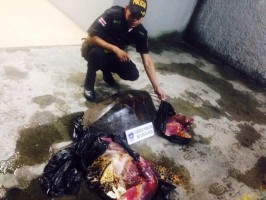
Source: MSP
Five men were arrested earlier this week after police officers found them in possession of a butchered sea turtle from a virtually extinct species that is just starting to return to Costa Rica. According to an official communication from the Ministry of Public Security, the incident occurred in Moin, a coastal district of the Caribbean province of Limon.
Officers from Fuerza Publica, the national police force of Costa Rica, were manning a roadway checkpoint on a road that connects with the port of Moin. These roadblocks are mostly conducted to check for smuggling of narcotics and illicit goods that are offloaded at the docks; in this case, however, the Fuerza Publica officers found a slain sea turtle in the rear luggage compartment of a passenger vehicle.
Inside a plastic garbage bag, the officers found the shell, flippers and entrails, but they did not find the head. One of the five suspects was known to the officers as a suspected poacher. The men were arrested and taken to a detention facility, where prosecutors charged them with violations of the Wildlife Conservation Law as well as the Law to Protect Sea Turtles in Costa Rica. These are felony offenses that could result in prison terms upon conviction.
The officers collected the sea turtle remains and called a biologist from the National Coast Guard Service of Costa Rica, who inspected the carcass and determined that it was a hawksbill, Eretmochelys imbricate. It is important to note that Fuerza Publica conducts beach patrols at night to protect nesting sea turtles in Limon; alas, their resources are limited.
As previously reported by The Costa Rica Star:
The few, critically endangered hawksbill sea turtles that still arrive in Costa Rica during nesting season may stop coming here altogether due to climate change. In the 21st century, hawksbills have barely arrived on the beaches of the Pacific coast. On the Caribbean shores, the number of Eretmochelys imbricata nests at the Cahuita National Park has been dwindling over the last few years despite strong efforts to protect them; regrettably, there’s not much conservationists can do to stop beaches from disappearing.
According to an IPS news report by Diego Arguedas for El Pais, hawksbills may be shying away from nesting in Cahuita because the beach is getting too cramped. Park administrator Mario Cerdas explained to IPS that the eight kilometers of beaches in Cahuita are getting reduced due to erosion and rising sea levels. The beaches along this Caribbean stretch of coastline in Costa Rica are nesting sites not just for hawksbills but also leatherbacks, loggerheads, and green sea turtles.



