


 SIGN UP FOR OUR
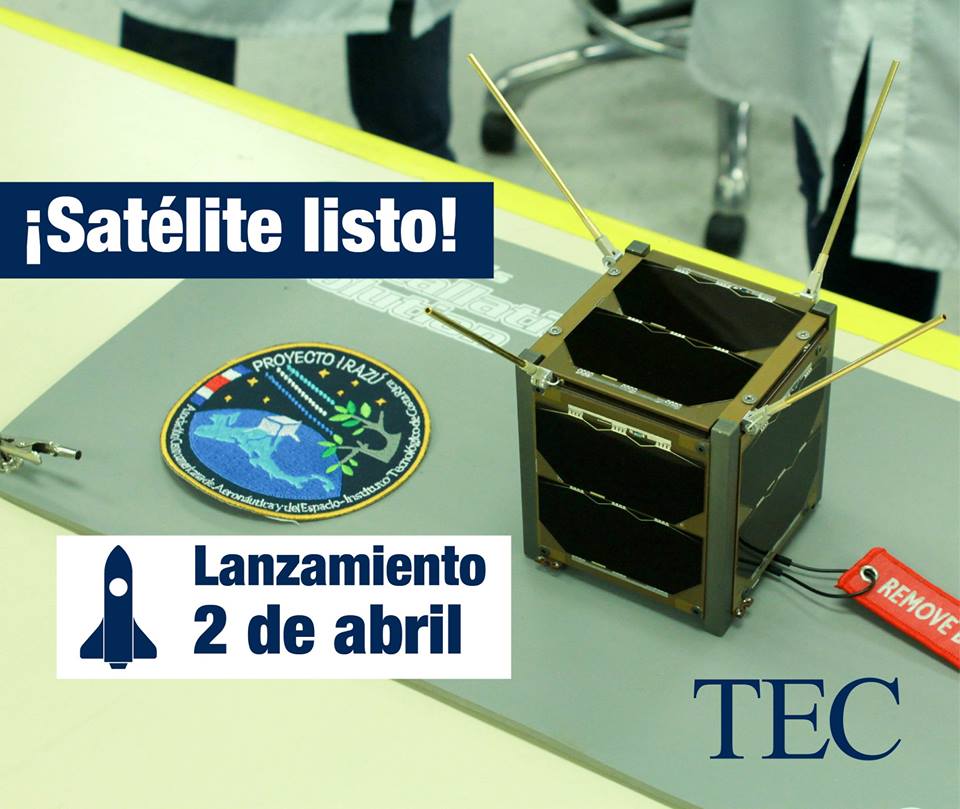
Costa Rica will launch on April 2 its first satellite to the International Space Station from Cape Canaveral, Florida, U.S.A.
This initiative known as Irazu Project (Space Technology for the Monitoring of Climate Change), is the result of the work of the Central American Association of Aeronautics and Space )CAAE for its Spanish acronym) and the Costa Rica Technology Institute (ITCR) with the support of several sponsoring companies, the government and donations received through kickstarter, the satellite was designed to help with different environmental investigations.
Students of the Technology Institute Juan José Rojas and Marcos Hernández were leading the project and worked hand in hand with scientists from the Kyutech Technology Institute in Japan.
Since February 21 the device was delivered to the Japanese Agency for Aerospace Exploration (JAXA) which will be in charge of sending it to space together with other satellites and the supply equipment for the International Space Station (ISS) on April 2.
American company SpaceX is in charge of the launching, which will be done with the famous rocket Falcon 9.
Costa Ricans will be able to witness the take off live, since SpaceX streams through YouTube all its launches.
“We are very proud to demonstrate that in Costa Rica we have the capacity to create space systems that comply without any problems with the strict standards of JAXA to launch a satellite to space”, stated Adolfo Chaves, coordinator of the Special Systems Laboratory of Costa Rica’s Technology Institute
The satellite was manufactured with CubeSat technology, a cube that measures only 10 centimeters (3.93 inches) each side and weighs close to 1 kilogram. The remote station was installed in a beechwood tree plantation in Los Chiles, Alajuela (North region of Costa Rica).
In this plantation, 10 instruments were installed to measure the growth of trees and the capture of carbon dioxide. Five of these devices were designed and built by students of the ITCR. A meteorological station was also placed here to analyze the forest growth in relation to climate variations.
Finally there is a station in Earth located at ITCR in Cartago where all information gathered by the satellite will be collected .



