


 SIGN UP FOR OUR
  Click here to view past “readers mail” questions that we have answered in published articles.
A couple of dear readers recently sent us questions regarding air travel in Costa Rica. We have consolidated their questions and respective answers to make it more informative for everyone.
A reader named Bill from Chicago asked general questions about our airports and airlines, whether it’s possible to bypass San Jose and fly in to Guanacaste’s fabulous beaches, and about flights from Costa Rica to other tourism hotspots in Central America.
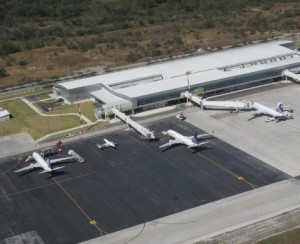
Thanks for writing, Bill. We have good news for you: Budget airlines USA3000 and Frontier are currently offering some direct and non-stop flights from Chicago O’Hare to Liberia’s spiffy-new Daniel Oduber Quiros International Airport (LIR) through American tour operator Apple Vacations. As we have previously reported, Guanacaste is becoming a prime destination for medical tourists, surfers, celebrities, and seasoned visitors -like you, Bill- who want to skip the hustle and bustle of the Juan Santamaria International Airport (SJO) and head straight for the balmy paradise beaches in the Nicoya Peninsula and our North Pacific shores.
Since you are flying in from Chicago, you will not have a problem flying in or flying back home. Besides the SJO and LIR airports, our other international airports are located in suburban San Jose (Tobias Bolanos) and Limon, and currently offer domestic flights and limited international service. The list of airlines that offer direct and non-stop service from different countries into Costa Rica is continuously changing, and thus I urge you to use sites like Kayak to search for air travel tickets. Websites like SkyScanner allow you to see all the airlines currently operating at a domestic and international level in our country, but air travel in Costa Rica has become an ever-changing industry, and is likely to remain that way for a while.
We are going to give you some old-fashioned advice, Bill; which you may be surprised to learn in the midst of our Information Age, but we’ll explain why it’s worthwhile: Consulting a travel agent is a good idea in this case. Travel agencies were thought to have suffered a painful demise thanks to the advent of the Internet, but quite a few of them have been making a quiet comeback. Air travel fell into a slump after the events of 9/11, and after the global financial crisis began in earnest in 2008 airlines turned to the surviving travel agencies to help them stay afloat during the (still) turbulent economic times. You can thank esteemed travel agencies like Apple in the United States and Thomas Cook in Europe for keeping some airlines in business (both offer flight packages to Costa Rica).
Travel agents are often well-connected and privy to exclusive information. For example, a travel agent recently notified us that there will soon be new regular service from France to SJO; although he could not reveal details as he was asked by the airline and airport authority to wait for release of the official communique. This travel agent in particular is already putting together tour packages in both countries and waiting until the official release so he can offer early discounts to his clients. The Internet has really shaken up the travel industry, and travel agents realize that they must be insiders and offer true value to clients in order to stay alive, thus it once again makes sense to retain their services. If once you are here you decide to fly to other places in Central America and the Caribbean, like Dominican Republic, Guatemala, and Panama, you can ask a travel agent to help you; or you can contact Copa Airlines, LACSA or TACA directly.
One more thing, Bill: we have learned that the same foreign currency exchange operator that is located at the arrivals terminal in SJO has opened up shop at LIR. Their exchange rates are notoriously slanted in their favor, so our advice to you is to hold off on exchanging dollars (or any foreign currency) until you have left the airport. Our national and private banks offer much more reasonable exchange rates than those offered at our airports.
A dear reader named Sonia from Vancouver Canada asked about our airport departure tax, whether it is limited to foreigners flying out of SJO, its raison d’etre, and why it is not levied at the terrestrial border crossings.
Hello Sonia. The exit tax you are referring is currently enforced at all of our international airports. Contrary to popular belief, the tax does not discriminate; it must be paid by all travelers going abroad, Ticos and otherwise. As you probably already know, it must be paid in either American dollars or colones prior to checking in. The tax is currently $26 (the tax is actually $28, thanks to Berni at Pura Vida Hotel for the update), and there was strong opposition to reducing the amount back in 2007. In certain cases, this tax can be paid in advance at some banks (Bancredito and Banco de Costa Rica come to mind), as well as at some hotels.
The tax is collected by decree of Law Number 8316, which effectively amended Law 5874. In its original version, the law was far more ambitious, as it intended to collect $30 from all travelers leaving the country; whether by land or by sea, by air or by zipline. Such a Law would have run afoul of our constitutional right to freely move around the country without restriction; something that does not apply to air or highway travel (think of our toll booths), because when you board a motor vehicle, an aircraft or a vessel, you are making a choice to surrender to a controlling governmental entity. That is why you see our Transit Police conducting roadblocks: when you get a driver’s license or sign a rental car agreement you are giving up your constitutional right to walk freely on foot. Think about the bus riders when they cross the border: they must get off the bus, clear immigration and customs, walk across to Nicaragua or Panama, and then get back on the bus. The process is largely done on foot, so there’s a constitutional protection to not being taxed. Lawmakers have vowed to get around this, but the most they have accomplished is to shift the exit tax solely to the airports of our country.
Costa Rica is hardly the only country that charges such taxes. Other nations simply include it in the purchase price of air fare. For example, the Mariscal Sucre International Airport in Quito, Ecuador, used to charge a little more than $40 back in 2008. Take a good look at your itemized air far ticket next time, Sonia, and I guarantee you’ll see all kinds of strange fees and taxes you were not aware of.
Ten percent of the exit tax revenue goes to the Municipality of Alajuela for the purpose of improving its water and sewage works. Five percent goes to a government program that gives free housing to homeless and low-income families. A couple of monuments and the Juan Santamaria historical museum have benefited from this tax. The rest of the money funds immigration and customs operations.
Some travelers are exempt from this exit tax, such as diplomats, prisoners, deportees, artists, and those who are in transit and staying in the country for less than 12 hours.



