


 SIGN UP FOR OUR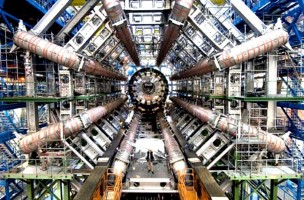
The LHC – Source: Flickr Commons
Geneva, Mar 14 (EFE).– An understanding of dark matter and its composition and the recreation of conditions billionths of a second after the big bang are two of the objectives that physicians at the European Organization for Nuclear Research, known as the CERN, are aiming to achieve now that the world’s largest and most powerful particle collider is up and running once again.
“For us, it’s thrilling that the accelerator is working again after two years in which much work was done to improve it and increase the energy of the collisions … and to know that perhaps we’re going to find new things,” Spanish physicist Maria Chamizo said in an interview with Efe.
Chamizo is a highly respected researcher at CERN who was responsible for the Compact Muon Solenoid, or CMS, experiment in 2012 and 2013, when that general-purpose particle physics detector discovered a particle matching the elusive Higgs boson, in what was the latest great find in physics.
The CERN has re-launched – by sectors – its so-called Large Hadron Collider, or LHC, which is expected to be fully operating in May, when it will be ready for its second three-year run.
The LHC, which consists of a 27-kilometre ring of superconducting magnets and is located under the Swiss-French border, was out of commission for two years, during which time a thorough technical review was carried out and the massive machine was opened up every 20 meters (65 feet) to check on the connections between the magnets and ensure their optimal performance.
Chamizo said the composition of dark matter could be one of the most interesting discoveries in this second run.
“There’s evidence, based on astrophysics experiments, that dark matter has to exist, but what is it made of? We don’t know,” the physicist said.
The matter we see represents only 5 percent of the universe, while 25 percent is dark matter and 70 percent is dark energy.
Some models predict that dark matter could be made up of particles that do not interact by well-understood electromagnetic forces.
Nevertheless, if they have mass they should interact with Higgs’ field, which explains how massless particles acquire mass.
Therefore, a more thorough study of the Higgs boson and its properties – which will be possible thanks to the more violent particle crashes to be achieved by the upgraded accelerator – could lead to the discovery of particles that make up dark matter, said Chamizo, a researcher with the Spain-based Center for Energy, Environment and Technological Research and a scientist on the CMS experiment, one of seven being carried out at the LHC.
Chamizo also said the bigger crashes with the upgraded collider will enable more massive particles to be produced and could provide answers to big mysteries surrounding the composition of the universe.
In one of the other experiments, known as ALICE, collisions of lead ions provided by the LHC will create extreme conditions similar to those just after the big bang.
Under those conditions, protons and neutrons – which are the building blocks of all ordinary matter in today’s universe and are made of quarks bound together by particles called gluons – “melt” and the quarks are freed from their bonds with the gluons.
The ALICE detector will investigate the properties of that primordial “hot soup” of matter, known as quark gluon plasma, that existed at the beginning of the universe.
“Increasing the energy of the collisions (in the accelerator) means going further back toward that origin,” Chamizo said. EFE



