


 SIGN UP FOR OUR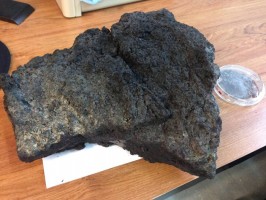
A baby volcanic rock in Costa Rica from the Turrialba volcano. Source: RSN
Earth scientists at the National Seismology Network (Spanish initials: RSN) of the University of Costa Rica issued a statement yesterday that underscores the need for emergency planning and disaster preparedness in the communities near the Turrialba volcano, in the province of Cartago. Magmatic levels at this active colossus are rising, and they are now just hundreds of meters away from the crater.
The brave RSN geologists, volcanologists and seismologists reached the summit of the Turrialba on Friday, and they found what they considered to be:
“[…] undisputed evidence of the presence of fresh chunks of lava, which were ejected in incandescent form and in a molten state [during previous eruptions]. These rocks indicate, without a doubt, the presence of young volcanic matter and fresh lava, which is just a few hundred meters beneath the surface of the active crater system.
These lava fragments represent baby volcanic rocks in Costa Rica; they are just five days old. Their composition seems to correspond to basaltic andesite [black volcanic rock], which is made up of minerals such as olivine and pyroxene [among others]. This type of lava is normal insofar as the volcanology of the active mountain ranges of our country.
Even though [previous] analysis of volcanic ash had already hinted as to the presence of fresh lava, today’s collection of lava chunks, which can be measured in decimeters, allowed us to reach a conclusion and estimation of lava levels.”
The RSN scientists also commented that, during their field visit to the Turrialba crater, they could feel surface vibrations, hear rocks below them being cracked, and witness the release of gas and vapor from the calderas. Both the RSN and the Observatory of Seismology and Volcanology of Costa Rica (Spanish acronym: OVSICORI) will continue to monitor the Turrialba volcano, which is currently under green alert and could be upgraded to yellow at any time.
The Turrialba is currently the most active colossus in Costa Rica, and it has been compared to a pressure cooker. Needless to say, this volcano is not open for visitors at this time.



