


 SIGN UP FOR OUR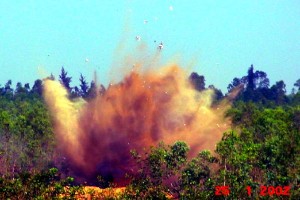
A landmine explosion. Source: Wikimedia Commons
By Cynthia de Benito
San Andres de Pisimbala, Colombia, Mar 21 (EFE).– To live in some of the 688 Colombian municipalities devastated by anti-personnel mines and other explosives, one must learn to look at the ground, a rule that hundreds of peasants have made a routine of their daily lives.
“The mines really change community life. Once we could go out walking at night – not any more. There’s a generalized fear that something can go wrong at any time and people now have no peace of mind,” “Javier,” a resident of San Andres de Pisimbala in the southwestern province of Cauca, told Efe.
“Javier” wouldn’t give his real name because there is still a certain resistance in his village to admit that explosive devices were found last October and November just a few meters (yards) from a children’s playground.
The populated area of San Andres is mountainous with just a few dirt roads, small houses and many secondary paths that its residents no longer use because of the danger.
They’ve been taught to be careful in training workshops offered by the Colombian Red Cross with the collaboration of the Spanish Red Cross and the Spanish Agency of International Cooperation for Development, or Aecid.
The situation in Colombia justified the mission – the country in 2012 was second in the world for landmine victims with a total of 368, and according to the Colombian Red Cross, 45 percent of its territory has had accidents from small arms contamination of the soil, of which 98 percent was in rural areas.
Children became the chief pupils of this training after four landmines were found last October behind a school.
“It was Sunday morning, and we were all going have a big lunch together. A teacher went to prepare the place to put the cooking pot and found the ground had been dug up,” “Javier” recalls.
That is the first sign. Notice that the ground has changed and study the surrounding area.
When there’s an explosion, the training takes on ways to help the victims, as found by Liliana Ceron, who still has shrapnel in one of her legs from a bomb that blew up last December in Inza, near San Andres.
“Every time my leg hurts I remember that moment. It’s very hard, it changes your life. You always think that nothing’s going to happen to you, but nobody gets away completely,” she said. EFE



