


 SIGN UP FOR OUR
 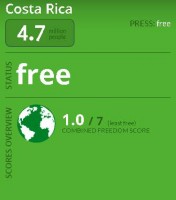 Two recent attempts by government officials to undermine press freedom in Costa Rica were thwarted by competent legislative and judicial officials. One case involves access to government information that should be made available with full transparency, and the other involves undue snooping on journalists by law enforcement agents with the help of a former communications monopoly that used to be controlled by government. In both situations, press freedom is being heralded as essential to the optimal functioning of a democracy.
The first case involves a request for information made by a journalist named David Delgado Cavana. Mr. Delgado requested statistics from the Ministry of Justice and Peace on prison overcrowding, an unpleasant side effect of the hardline approach to national security and law enforcement applied by the administration of former President Laura Chinchilla. While there is no question that Costa Rica improved significantly in terms of security during the previous administration, there was no adequate planning insofar as what to do with all the individuals receiving prison sentences.
Justice Minister Cristina Ramirez declined to provide statistics on prison overcrowding, which is an issue that has been previously reported by The Costa Rica Star along with various other news media outlets in Costa Rica. According to Minister Ramirez, granting the journalist’s request would compromise national security. That was not the opinion of the magistrates serving Costa Rica’s highest court, the Constitutional Chamber, which is colloquially known as Sala Cuarta. By means of a ruling on case # 2015-0919-0007-CO, Sala Cuarta determined that the Ministry should grant the journalist request since prison overcrowding is an issue that merits public disclosure.
The second case involves the Investigation Unit of the Costa Rica Electricity Institute (Spanish initials: ICE), which held a monopoly on telephony until a few years ago. This shadowy wiretapping unit was involved in the bizarre espionage case involving star goalkeeper Keylor Navas, who plays in the Real Madrid Football Club in Spain. The snooping was conducted by various law enforcement agents assigned to the Office of Judicial Investigations (Spanish initials: OIJ) with the help of ICE. This case was unearthed by journalists from the daily tabloid Diario Extra, which has been spied upon by OIJ agents who were not aware that the newspaper has its own set of insiders within that government agency.
According to national newspaper La Prensa Libre, the Director of Diario Extra and a spokesperson from the ICE wiretapping unit were called in to testify before the Legislative Assembly about the Keylor Navas case, and several legislators were shocked and angry at the unrestrained monitoring conducted by ICE on behalf of the OIJ. Legislators are considering enacting orders to shut down the snooping unit at ICE and they recommended that in the future all wiretapping should be conducted directly by OIJ, but only under the strict supervision of judges on a 24-hour basis and with proper search warrants approved by courts.
According to Reporters Without Borders, Costa Rica and Uruguay enjoy auspicious levels of press freedom in Latin America; however, government threats against such freedoms must be investigated and curtailed as the examples above show.
Source: La Prensa Libre (Costa Rica)



