


 SIGN UP FOR OUR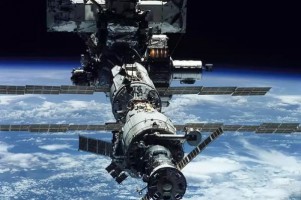
ISS. Source: Wikimedia Commons
Washington, Mar 28 (EFE).– The Soyuz TMA-16M spacecraft arrived successfully at the International Space Station, or ISS, with three astronauts aboard, two Russians and an American, on a mission that makes history because two of its crew will join the very few who have stayed the longest time in space.
The spacecraft blasted off at 1942 GMT from the cosmodrome in Baikonur, Kazakhstan, and docked at the ISS at 0133 GMT, NASA said during its live online coverage of the flight.
On this occasion, two of the three crew members who arrived on the Russian Soyuz spacecraft will remain on the ISS for a year, twice the time that astronauts usually stay there.
In the entire history of space missions, only four other astronauts have remained so long in space.
The record is held by Russian cosmonaut Valeri Polyakov, who spent 437 days in 1994-1995 on the Mir space station, the Soviet predecessor of the ISS, dismantled in 2001.
The American Scott Kelly, 51, and Russia’s Mikhail Kornienko, 54, will remain in orbit until March 2016 to test the effects on the human body of being in space for long periods of time, as a guide for future missions exploring the solar system.
Scott Kelly has a twin brother, retired astronaut Mark Kelly, who will also take part in the trial so the effects of different environments on their respective organisms can be compared.
So while Scott’s vital signs will be monitored during his year of orbiting at some 400 kilometers (250 miles) from Earth at a speed of around 27,000 kph (17,000 mph), Mark will undergo regular medical examinations that, by way of comparison, will help understand how the body reacts to zero gravity and space radiation.
While on the longest mission ever aboard the International Space State, the astronauts will carry out around 500 experiments.
The third crew member of the Soyuz TMA-16M, Russian cosmonaut Gennady Padalka, 56, with this mission will beat the record for non-consecutive days that a man has been in space: when he returns to Earth six months from now, he will have spent a career total of 878 days in space.
Waiting to greet the crew of the Russian spacecraft were the current occupants of the ISS – Italy’s Samantha Cristoforetti, the Russian Anton Shkaplerov and Terry W. Virts of the United States.
The International Space Station is a project valued at more than $100 billion that orbits between 335 and 460 kilometers (208 and 286 miles) from Earth and weighs more than 450 tons.
The space platform orbits at a speed of some 27,000 kph (17,000 mph) and has had astronauts aboard continuously since the year 2000, with 16 nations taking part. EFE



