


 SIGN UP FOR OUR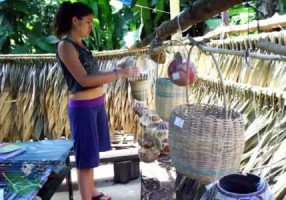
Bribri woman artisan in Costa Rica
During any given week at university campuses around the world, the thorny topics of feminism, gender roles and female empowerment are perennially discussed and dissected by students and faculty. Lecturers, researchers, activists, and observers are all part of a sociopolitical microcosm dedicated to controversy. In the Talamanca Region of Costa Rica, however, feminism has been an inscrutable aspect of indigenous life over several centuries.
At a Northern Ireland gallery, visual artist Sarah Maple is proudly exhibiting her God is a Feminist collection. In a few days, Gloria Steinem will appear at the Massachusetts College of Liberal Arts. In New York City, young women are wearing stylish black t-shirts emblazoned with slogans such as “Fine Ass Feminist” and “Supreme Bitch.” At Duke University, a female student who pays her tuition using proceeds derived from her work as a pornographic actress is heralded as a modern feminist.
Meanwhile, in the Amubri village of Talamanca in Costa Rica, Intercontinental Cry author Courtney Parker recently investigated the Bribri people and their matriarchal legacy that has been in place since before the Spanish Conquistadors arrived:
The Bribri’s matriarchal clan structure means that tribal lineage is passed down through the mother, and knowledge and tradition is passed down by the grandmother.
This mission that the Bribri collectively took on, to live out the matriarchal vision in alignment with the Earth Mother, is one that can and should inspire women leaders, activists, scholars, freethinkers, and seekers and defenders of a world in balance, everywhere.
Perhaps by nature of (and a tribute to) this feminine base of dignity and strength, the Bribri currently have a tenacious grasp on their traditional tribal language and sustain a robust indigenous culture, even as the surrounding nation of Costa Rica has kept pace with many of the homogenizing development patterns that globalization brings.
Parker also observes that the current wave of feminism in Latin America is a lot more natural and community-based than in North America and Europe. The Costa Rica Star has previously presented a similar observation with regard to the minimum female representation at the Legislative Assembly as required by law, as well as the political rise of President Laura Chinchilla and her counterparts in Argentina, Brazil, Chile, Jamaica, and Trinidad and Tobago.
It is an ancient tradition in Talamanca that women can assume any shamanic position of leadership, but they cannot be warriors or undertakers since that would put them in touch with the dead and belie their roles as breathers of life. What is interesting about this is that women in Talamanca are also chosen as Siatami, guardians of the sacred oracular stones. This has lead researchers such as Alberto Sibaja Alvarez to speculate about the mysterious purpose of the magnificent stone spheres that can be visited in their own National Park in Palmar Sur de Osa. Could the roundness of the stones be an allusion to fully pregnant tummies and the matriarchal model of the indigenous people of Costa Rica?



