


 SIGN UP FOR OUR
 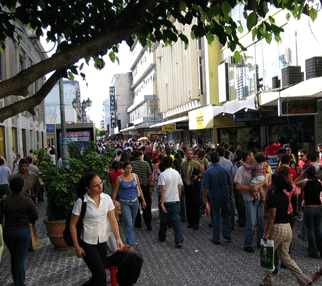 Miami, June 13, 2012: Tourists are in love with Costa Rica. This is indicated by the US$1.3 billion to spend this year in our country, 15% more than in 2011, according to the second annual Global Destinations Cities Index from MasterCard. The research reveals that San Jose, Costa Rica, ranks sixth in disbursement of money for tourists. The first place is Mexico, the second Buenos Aires, the third Sao Paulo, the fourth Lima, and the fifth Bogota.
The amount of international travelers visiting top destination cities in Latin America and the Caribbean (LAC) is expected to increase, totaling 16.6 million visitors in 2012. The growth figures for Latin America show real signs of positivity, with projected visitor numbers up by 7.3% for the top ten destination cities in the region and total predictions for international spend growth at 7.9%.
According to the Index, despite a challenging economic climate, the overall travel and tourism picture is predicted to improve, with the number of international visitors and their spending projected to increase in 2012.
“In spite of a challenging global economic backdrop, this year’s Index projects that there are hotspots of robust growth around the globe, in terms of both international visitor arrivals and expenditure,” said Dr Yuwa Hedrick- Wong, Global Economic Advisor for MasterCard Worldwide and author of the report. “For example, you now have Rio de Janiero’s travel trajectory trending upwards as it prepares to host important global sporting events in the coming years.”
Emerging city destinations are also making their mark in 2012 when it comes to growth in visitor numbers with cities such as Recife, Belo Horizonte and Rio de Janeiro in Brazil and Monterrey in Mexico which are all set to experience increased visitor numbers.
Meanwhile, other cities including Quito, Bogota and San Jose are predicted to enjoy increased international visitor spend this year.
“It is important to understand the role Latin American cities play when taking a look at global commerce and how electronic payments enable international travelers to make safe, simple and smart payments anywhere in the world,” said Richard Hartzell, President, MasterCard Latin America and Caribbean region. “This Index indicates that Latin America and the Caribbean are attracting more international travelers and we want to help facilitate the growth of cashless commerce.”
The MasterCard Index of Global Destination Cities ranks cities in terms of the number of their total international visitor arrivals and the cross-border spending by these same visitors in the destination cities, and gives visitor and passenger growth forecasts for 2012.
This Index and the accompanying reports are not based on MasterCard volumes or transactional data.
LAC Rankings for the 2012 Global Destinations Cities Index
Topping the charts as destination cities from the region by international travelers are: 1) Mexico City, Mexico; 2) Buenos Aires, Argentina; 3) São Paulo, Brazil; 4) Lima, Peru; 5) Bogota, Colombia; 6) San Jose, Costa Rica; 7) Santo Domingo, Dominican Republic; 8) Rio de Janeiro, Brazil; 9) Caracas, Venezuela and 10) Quito, Ecuador.
The top ten destination cities in LAC by international visitor spend are: 1) Buenos Aires, Argentina; 2) São Paulo, Brazil; 3) Mexico City, Mexico; 4) Lima, Peru; 5) Bogota, Colombia; 6) San Jose, Costa Rica; 7) Rio de Janeiro, Brazil; 8) Santo Domingo, Dominican Republic; 9) Caracas, Venezuela and 10) Quito, Ecuador.
International Travelers to LAC Destination Cities
Brazil shows strongest growth rates for the region
-Although not included in the Top Ten for the LAC region, Recife will be the fastest growing regional city within the report in terms of visitor numbers with a striking anticipated growth of 37.6%, followed by Rio de Janeiro with a remarkable 28.6% growth rate.
-Quito, who shows an expected growth rate of 18.8%, moves into the LAC Top Ten list for the first time.
-Mexico City, with 3.5 million arrivals, is expected to receive more visitors than any other city in Latin America making it the top destination in the region. Buenos Aires follows in second place with 2.6 million visitors. In fact, more international travelers are expected to visit Mexico City and Buenos Aires (3.5 million and 2.6 million) than San Francisco, Washington D.C, Atlanta, Vancouver and Houston.
Inbound Travelers to LAC Mostly Come From the US or the Region Itself
-Based on air travel, most visitors traveling to the top destination city in LAC – Mexico City – are coming from the US including Miami, Houston, New York and Los Angeles. While visitors from Miami and New York to Mexico City are growing at 17.1% and 12.5% respectively, visitors from Los Angeles and Houston are declining by 20.7% and 0.8% respectively.
Visitor Spending in LAC
Travelers spend the most in Buenos Aires, followed closely by Sao Paulo
-Aside from high numbers of visitor arrivals, Buenos Aires currently ranks highest among LAC cities by visitor expenditure, with US $3.0 billion. Sao Paulo follows closely with US $2.9 billion, dropping to second place after being top ranked in 2011 with international visitor spending declining by 5%.
-Quito, coming in tenth place, shows the strongest growth rate for amount spent by visitors at an astonishing 26.3%, followed by Bogota at an impressive 24.8%.
-International visitor spending in Caracas is expected to see a sharp decline of 9.3% compared with the 2011 level.
-Though there is set to be a lower average international spend per visit of $982 in LAC, this figure is up by 0.6% from last year.
For the second year in a row, London comes in as the world’s most popular destination city for overseas travelers. The top overall ranking is based on a predicted uplift of international visitor numbers by 1.1% to a record 16.9 million, while visitors’ spend is set to increase by a sizzling 10.3% to $21.1 million. MasterCard also projects that if current growth continues, London may well be a so-called ‘cashless capital’ by 2025, when the number of electronic payments will be greater than the number of cash transactions.
For further information, please contact:
Gabriela Zamora, [email protected], tel. 2283-8891.
Methodology
The MasterCard Worldwide Index of Global Destination Cities is compiled using international flight and flight capacity information purchased from OAG Global, a provider of international aviation data. Flight schedules are also used for calculating flight frequency between pairs of cities. Airlines also publish on a regular basis their historical load factor, and advance flight schedules, which are then used to estimate the actual outbound passenger departures, and for forecasting outbound passenger departures in the coming year.
On any given flight there are visitors from the departure country, returning residents of the destination city after visiting the departure country, and a third group: non-residents connecting through the departure country to the destination city on their way to a second destination city. This group can be a low proportion of the passengers for typically non-hub cities, but very high for destination cities that are “hubs” such as Singapore, Amsterdam, and Frankfurt.
On a country level, the UN Database of “Trade in Service” in the “Travel Component” provides estimates of how much each year residents spend abroad (air fare paid in home country not included). An algorithm is applied to this total outbound expenditure and estimated total number of outbound passengers to derive an estimate of average per outbound passenger’s expenditure overseas.
A margin of error is also unavoidable in such estimates, as not all outbound trips are of equal length, and the cost of living varies a great between arrival cities such that even if each trip of equal length, expenditure per passenger between different arrival cities would still be very different.
This margin of error is reduced significantly by imposing a minimum of expenditures in the algorithm, after a number of iterative testing (US$500 per trip for bordering arrival country and US$700 per trip for non-bordering arrival country).
Please note the city rankings from the 2011 MasterCard Index of Global Destination Cities are altered retrospectively as updates in data become available.
About Dr Yuwa Hedrick-Wong, Ph.D., Global Economic Advisor, MasterCard Worldwide
Dr Yuwa Hedrick-Wong is a business strategist and economist with 25 years of experience gained in over thirty countries. He was appointed Global Economic Advisor to MasterCard Worldwide in 2009. Prior to this role, he was Economic Advisor to MasterCard in Asia/Pacific, a position he held since 2001. As economic advisor, he chairs a MasterCard Knowledge Panel of leading economists, policy analysts, academics and business strategists for regular exchange and knowledge sharing. In 2007 he was appointed Advisor at Southern Capital Group, a private equity fund; and in 2008 he was appointed to the Investment Council of ICICI, India’s largest private bank.
Yuwa is also currently the HSBC Visiting Professor of International Business at the University of British Columbia, Vancouver, B.C. Canada, and is a frequent speaker at numerous international high-profile conferences.



