


 SIGN UP FOR OUR
 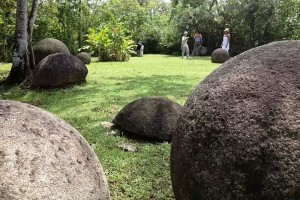 At Finca 6 in Palmar Sur of the Osa canton yesterday, President Luis Guillermo Solis and representatives from the United Nations Educational Scientific and Cultural Organization (UNESCO) unveiled the official plaque commemorating the declaration of the National Park of the Stone Spheres as a World Heritage Site.
The Mayor of the Osa canton and officials from the National Museum of Costa Rica were also present at this ceremony, which happens to coincide with the 100th anniversary of the cantonal municipality. The National Park of the Stone Spheres in Costa Rica is one of the most important efforts to preserve our country’s archeological record. Now that this pre-Columbian site has been entered in UNESCO’s registry, it will be easier to obtain funding and to attract more visitors.
As reported by Marco Leandro of daily tabloid Diario Extra, President Solis addressed those in attendance by suggesting that the stone spheres were originally used as instruments of astronomy, but this is hypothesis. To this day, archeologists and anthropologists have not fully determined why and how the stone spheres were originally used by ancient indigenous tribes. As previously reported by The Costa Rica Star:
A lot of research and conjecture has gone into our mysterious spheres, and there is a consensus that points to uncertainty as to their true purpose. We know the Boruca people made them, and we think the Bribri used them, but what for?
The Bribri people are considered to be the earliest astronomers of the Americas, one of the reasons why Dr. Franklin Chang-Diaz of Ad Astra named his future Mars spacecraft project Bekuo -the Bribri term for shooting star.
In the past, it was believed that the triangular alignment of the stone spheres had something with magical beliefs centered on the solstice and the equinox , but such speculation was discarded.
Current research on the spheres will be centered on agricultural calendars, meaning that ancient indigenous people in the region, may have planned their crops in accordance to the alignment, which signals the transition from the dry season to the rainy or green season. In other words, a strong hypothesis indicates that the spheres were used to track the zenithal path of the Sun, which suggests that Bribri astronomers may have known about the spherical shapes of celestial bodies.



