


 SIGN UP FOR OUR
 Washington, DC, Feb. 9 — Federal appellate judges on Thursday decided unanimously to uphold an injunction issued by a lower court last week blocking President Donald Trump’s executive order to temporarily bar residents of seven Muslim-majority countries from entering the United States.
This is the 45th president’s first major legal challenge, and his first major blow, after signing numerous executive orders since taking power in January.

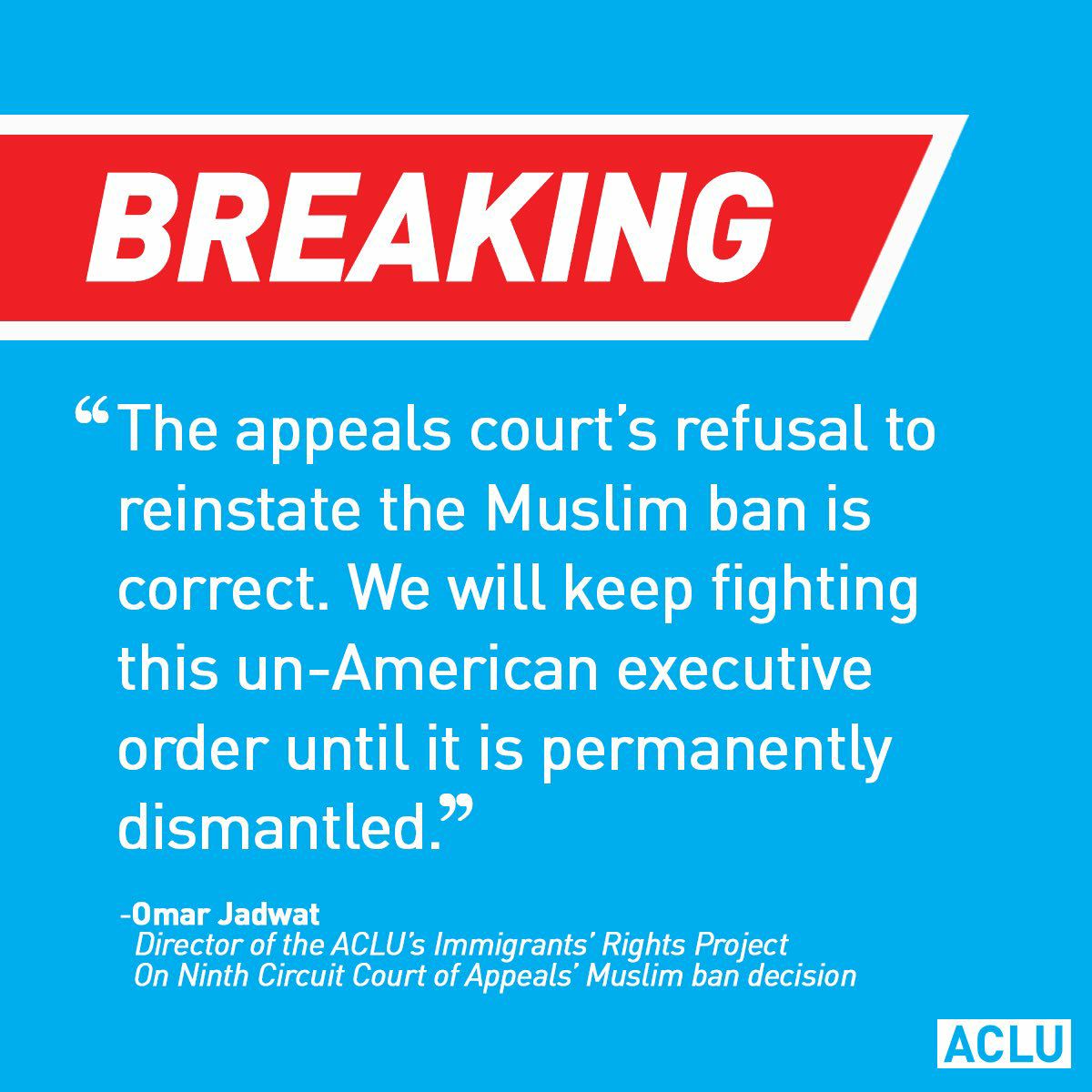
A three-judge panel of the U.S. 9th Circuit Court of Appeals in San Francisco rejected the Trump administration’s motion to reinstate the Jan. 27 executive order.
Trump’s order mandated a temporary pause in admission of refugees, a 90-day prohibition on entry by residents of Iraq, Syria, Sudan, Iran, Somalia, Libya, and Yemen, and an indefinite suspension of admission of Syrian refugees.
The appellate judges concluded that the order should remain in abeyance pending a final court ruling on its legality. The full text of the ruling can be found on the Internet at the attached link.
The president immediately took to Twitter to announce his intention to appeal Thursday’s decision.
“SEE YOU IN COURT, THE SECURITY OF OUR NATION IS AT STAKE!,” Trump tweeted on his personal account, in capital letters.
The administration can ask for a review of the panel’s decision by the full 9th Circuit, or it can seek intervention by the U.S. Supreme Court, which is still one short of its normal complement of nine members, creating the possibility of a 4-4 deadlock.
A tie in the Supreme Court would allow the appellate ruling to stand.
The 9th Circuit panel declined to overturn the restraining order issued last Friday by a federal district judge in Seattle, James Robart, acting on a motion from the attorney general of the state of Washington.
Judges Michelle T. Friedland, William C. Canby Jr., and Richard R. Clifton said the Trump administration failed to demonstrate that suspension of the executive order posed a threat to national security.
The administration says that the executive order was meant to give time to develop a procedure for “extreme vetting” of Muslims seeking to enter the United States, something Trump proposed during the presidential campaign after his initial call for an outright Muslim ban drew criticism from across the political spectrum. Vetting procedures are already in effect for immigrants and refugees entering the U.S.
Roughly 1,000 State Department career employees have signed a memo denouncing the executive order.
The Cato Institute, a libertarian think-tank in Washington, has pointed out that since at least 1975, no terrorist attacks have been carried out on U.S. soil by nationals of the seven nations affected by the visa suspension. EFE



