


 SIGN UP FOR OUR
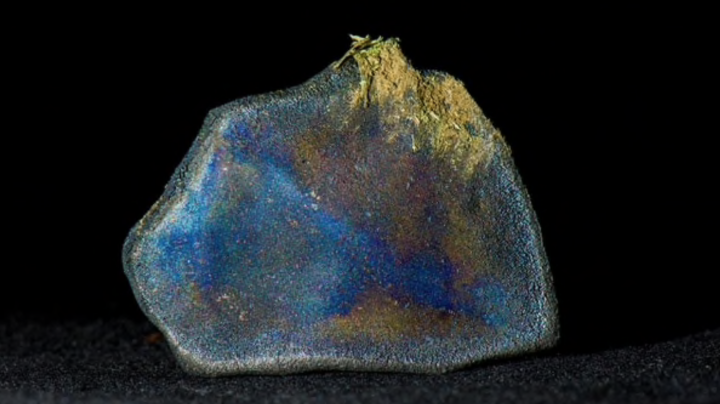
Did you know that meteorites are rarer than gold, platinum, diamonds or emeralds? They are worth as much as $1,000 a gram, meaning one weighing one pound could be worth one million dollars. Last year, a meteorite fell to earth in Aguas Zarcas, San Carlos, and this week the prestigious American Association for the Advancement of Science predicted that same meteorite could hold the secret to how the earth was born.
It seems that a woman was sitting at home watching TV last year, when she heard a crash. She went to investigate, and saw there was now a hole in her zinc roof. There was a rock wedged between two halves of a folding table – a meteorite had fallen out of the sky and into her casita.
Mauricio Mora, director of the Geology School at University of Costa Rica remarked about this event, “The country has no protocols to manage these situations, like when a meteorite falls at Aguas Zarcas.” The university was skeptical that it was truly a meteorite that had fallen through the woman’s roof. “There are no laws in Costa Rica regarding meteorites.”
Nonetheless, an elite group of meteorite hunters immediately boarded airplanes bound for San Jose, hoping to witness the meteorite – if it was one – first hand. The lady whose roof the meteorite damaged wished to remain anonymous. She was the owner of a one kilo+ stone of black velvet, that had probably been the size of a washing machine before hitting the earth’s atmosphere.
After studying the Aguas Zarcas space stone, University of Costa Rica’s geologists concluded that it was in fact a meteorite, one that had the chemical, isotopic and mineralogical makeup of rocks millions of years ago in our solar system. The last time such a meteorite had been found in Costa Rica was in 1857, and they named it Meteorite Heredia. These meteorites provide a window for scientists through which to study the early solar system, and learn about how it developed. The Aguas Zarcas meteorite is probably 4,560 years old, scientists believe.
The discovery of the Aguas Zarcas meteorite caused a frenzy in the area where it was found. News traveled quickly that foreigners were trampling through farms looking on people’s roofs for meteorites, and offering good money for fragments big and small. In addition to the piece that fell through the woman’s roof, two more large chunks were discovered in the area, as well as many smaller pieces that were found by farmers on their fincas. Children scavenged country roads hoping to find a piece of the meteorite to keep.
Farmers reported having heard an explosion and having seen a bright flash of light that night. The meteorite was subjected to heat of 1500 degrees centigrade, and in fact, the woman whose roof the main specimen pierced, said it was hot to the touch. She elected to keep the meteorite for her family.
Of the three largest meteorite fragments, the biggest piece was purchased by Terry Bodreaux, a retired medical executive, and donated to the Chicago Field Museum in the United States. It weighed in at 1,071 grams. The cost of the purchase was not revealed. Many of the smaller pieces were purchased by collectors, and fragments were sold on Ebay for $100 and up. The most expensive meteorite sold to date was a 1,433 pound specimen from Kiowa County, Kansas, which sold for $1.2 million dollars in 2016.
University of Costa Rica faculty explained the importance of this event, “The Aguas Zarcas event is an extraordinary find and of a great scientific interest at a national and international level that transcends any possible economic value that may be assigned to the fragments.” The Smithsonian Institution in the US explained, “These meteorites give you a sense of wonder, as seeing something extraterrestrial is always very strange. It’s a strange thing to hold a piece of another planet or a rock from space as for most of us, it is the closest we will ever get.”
It is also strange to imagine becoming very rich just by finding a meteorite on your roof, or in your field. The magic of Costa Rica!
About the Author :



